
Early-bird rate
0
Day 00
: 00
: 00
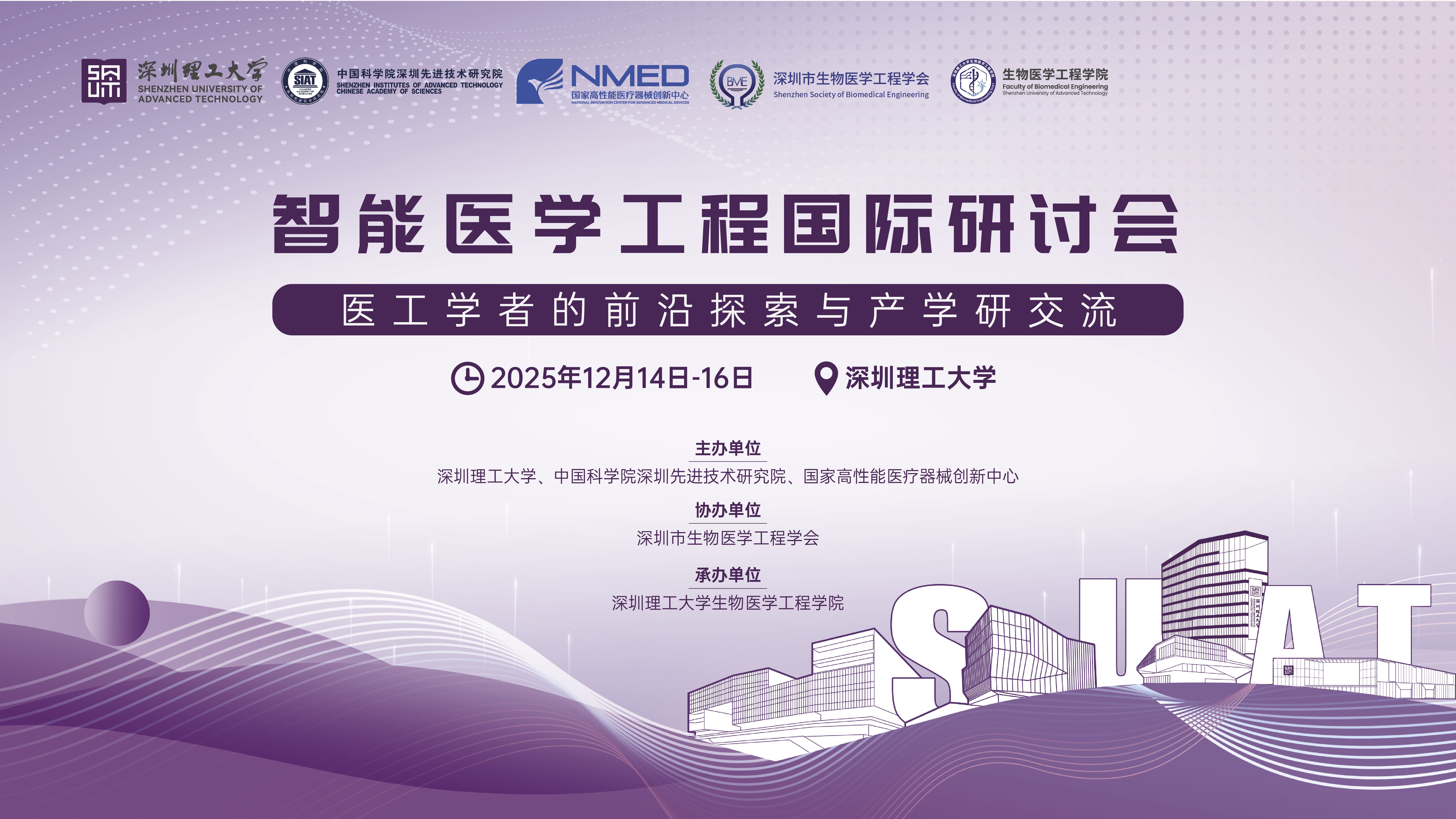
In response to the national "14th Five-Year Plan for National Health" strategic deployment of "promoting the deep integration of medicine and engineering technology and accelerating the R&D and application of intelligent medical equipment," and to address industry pain points such as "difficult translation of technology into clinical practice, insufficient multidisciplinary collaboration, and poor alignment with international standards" in the field of intelligent medical engineering, the School of Biomedical Engineering at Shenzhen University of Science and Technology will host the "2025 International Forum on Intelligent Medical Engineering" from December 14 to 16, 2025, in Shenzhen. December 14 is designated for registration and check-in, making the forum a three-day event.
为响应国家《“十四五” 国民健康规划》中 “推动医学与工程技术深度融合,加快智能医疗装备研发与应用” 的战略部署,破解智能医学工程领域 “技术临床转化难、多学科协同不足、国际标准对接不畅” 等行业痛点,深圳理工大学生物医学工程学院拟于 2025 年 12 月 14 日至 12月 16日在深圳市举办 “2025 智能医学工程国际研讨会”(英文名称:2025 International Forum on Intelligent Medical Engineering),12月 14 日为注册报到日,会期共计 3 天。
Currently, driven by the dual forces of global digital transformation in healthcare and the rapid iteration of artificial intelligence technologies, intelligent medical engineering has become a core force in reconstructing the entire chain of disease prevention, diagnosis, treatment, and rehabilitation. From AI-assisted medical imaging and precise surgical robot operations to real-time health monitoring via wearable devices and digital therapeutics for chronic disease intervention, related technologies are breaking through the limitations of traditional medicine. They offer new solutions to public health challenges such as "uneven distribution of high-quality medical resources, low efficiency in diagnosing complex diseases, and high costs of chronic disease management." While China has achieved localized breakthroughs in the field of intelligent medicine (e.g., the clinical application of domestically produced surgical robots and the widespread use of AI-based fundus screening in primary care), it still faces challenges such as "difficulties in integrating multi-modal medical data, insufficient clinical generalizability of core algorithms, and poor alignment with international certification systems." Under the theme "Empowering Healthcare with Intelligence, Integrating Engineering and Medicine—Co-creating a New Future for Intelligent Medicine," this forum will focus on three key directions: breakthroughs in core intelligent medical technologies, practices in clinical translation, and models for industry collaboration. It aims to share the latest scientific research achievements and industrial experiences in the field of intelligent medical engineering both domestically and internationally, deeply discuss industry development opportunities and bottlenecks, and build a platform for communication and collaboration among global research institutions, clinical hospitals, enterprises, and policy departments. The goal is to promote the precise alignment of technological innovation with medical needs and advance China's intelligent medical industry toward "global technological leadership and international standard dominance."
当前,在全球医疗健康数字化转型与人工智能技术快速迭代的双重驱动下,智能医学工程已成为重构疾病预防、诊断、治疗与康复全链条的核心力量。从 AI 辅助影像诊断、手术机器人精准操作,到可穿戴设备实时健康监测、数字疗法干预慢性疾病,相关技术正突破传统医疗局限,为解决 “优质医疗资源分配不均、疑难病症诊断效率低、慢性病管理成本高” 等民生问题提供新路径。我国在智能医学领域已实现局部突破(如国产手术机器人临床落地、AI 眼底筛查基层普及),但仍面临 “多模态医疗数据融合难、核心算法临床泛化性不足、国际认证体系衔接不畅” 等挑战。本次研讨会以 “智赋医疗・工医融合 —— 共创智能医学新未来” 为主题,聚焦智能医学核心技术突破、临床转化实践、产业协同模式三大方向,旨在通过分享国内外智能医学工程领域的最新科研成果与产业化经验,深入探讨行业发展机遇与瓶颈,搭建全球科研机构、临床医院、企业、政策部门的交流合作平台,推动技术创新与医疗需求精准对接,助力我国智能医学产业向 “全球技术引领、国际标准主导” 方向迈进。
The conference is hosted by Shenzhen University of Advanced Technology, the Shenzhen Institute of Advanced Technology of the Chinese Academy of Sciences, and the National Innovation Center for High-Performance Medical Devices, and co-organized by the Shenzhen Society of Biomedical Engineering. Additionally, 12 field experts from international institutions such as Kyoto University in Japan and the University of Southern Queensland in Australia have been invited to serve as academic advisors, ensuring the conference's academic authority and global perspective.
会议由深圳理工大学,中国科学院深圳先进技术研究院,国家高性能医疗器械创新中心主办,深圳生物医学工程学会协办,同时邀请日本京都大学、澳大利亚南昆士兰大学等国际高校的12 位领域专家担任学术顾问,确保会议学术权威性与国际视野。
The total number of participants is expected to be 150, including 22 international guests from the United States, Germany, Japan, South Korea, and Singapore. Participants will encompass scholars from universities and research institutions, clinical doctors, healthcare administrators, and corporate R&D personnel, achieving comprehensive coverage of the "industry-university-research-application-medicine" ecosystem.
预计参加会议的总人数将达到150人,其中包括来自美国、德国、日本、韩国和新加坡的22名国际嘉宾。参与者将包括来自知名高校和研究机构的学者、临床医生、医疗保健管理人员和企业研发人员,实现“产学研医”生态系统的全面覆盖。
1. Conference Honorary Chairs:
Jie Chen (Fudan University)
Ning Gu (Nanjing University)
Guohui Su (Jinan University)
Hairong Zheng (National Innovation Center)
2. Conference Chairs:
Dong Liang (Shenzhen Institute of Advanced Technology, Chinese Academy of Sciences)
Bing Song (Shenzhen Institute of Technology)
3. International Committee Co-Chairs:
Zhanfeng Cui (University of Oxford, UK)
Colin McCaig (University of Aberdeen, UK)
Jun Saiki (Kyoto University, Japan)
Shintaro Funahashi (Kyoto University, Japan)
Li Su (University of Cambridge, UK)
Ah Hwee Tan (Singapore Management University, Singapore)
Toshiya Murai (Kyoto University, Japan)
Swee Hin Teoh (Nanyang Technological University, Singapore)
William Richardson (University College London, UK)
Wenxue Jun (Clemson University, USA)
Yan Li (University of Southern Queensland, Australia)
4. Technical Committee Co-Chairs:
Xin Chen (Shenzhen University)
Qi Chen (Shenzhen University)
Yanan Du (Tsinghua University)
Jiahong Gao (Peking University)
Peiyi Gao (Beijing Tiantan Hospital, Capital Medical University)
Xiaorong Gao (Tsinghua University)
Zhen Gu (Zhejiang University)
Zhongze Gu (Southeast University)
Hongbin Han (Peking University)
Xingyu Jiang (Southern University of Science and Technology)
Yuxiao Lai (Shenzhen Institute of Advanced Technology, Chinese Academy of Sciences)
Jinsong Li (Zhejiang University)
Guanglin Li (Shenzhen Institute of Advanced Technology, Chinese Academy of Sciences)
Xuekui Wu (The University of Hong Kong)
Tao Li (Nanjing University)
Yuanqing Li (South China University of Technology)
Hongen Liao (Shanghai Jiao Tong University)
Bifeng Liu (Huazhong University of Science and Technology)
Heng Liu (National Innovation Center)
Honghai Liu (Harbin Institute of Technology)
Xin Liu (Shenzhen Institute of Technology)
Baoliang Lü (Shanghai Jiao Tong University)
Dong Ming (Tianjin University)
Dinggang Shen (ShanghaiTech University)
Yong Shen (University of Science and Technology of China)
Jing Tu (Southeast University)
Guangzhi Wang (Tsinghua University)
Jinwu Wang (Ninth People's Hospital Affiliated to Shanghai Jiao Tong University School of Medicine)
Jun Wang (South China University of Technology)
Xuekui Wu (The University of Hong Kong)
Liangde Xu (Wenzhou Medical University)
Qingsong Xu (University of Macau)
Zhiming Xu (Shenzhen Institute of Technology)
Xiangyang Xue (Fudan University)
Tianyi Yan (Beijing Institute of Technology)
Dezhong Yao (University of Electronic Science and Technology of China)
Shengyuan Yu (Chinese PLA General Hospital)
Chao Zhang (Sun Yat-sen University)
Xu Zhang (Capital Medical University)
Yu Zhang (Southeast University)
Hong Zhou (Zhejiang University)
5. Technical Committee Members:
Shichun Bao (National Innovation Center)
Zhitong Chen (National Innovation Center)
Sheng Ge (Southeast University)
Yongshuai Ge (Shenzhen Institute of Advanced Technology, Chinese Academy of Sciences)
Jiaye He (National Innovation Center)
Yi He (National Innovation Center)
Zhanli Hu (Shenzhen Institute of Advanced Technology, Chinese Academy of Sciences)
Jiehui Jiang (Shanghai University)
Yue Leng (Southeast University)
Shanshan Liang (National Innovation Center)
Chunlin Li (Capital Medical University)
Zhiyuan Liu (Shenzhen Institute of Advanced Technology, Chinese Academy of Sciences)
Xiao Li (National Innovation Center)
Ye Li (Shenzhen Institute of Advanced Technology, Chinese Academy of Sciences)
Zhe Li (Nanjing University)
Zhicheng Li (Shenzhen Institute of Advanced Technology, Chinese Academy of Sciences)
Zhigang Lu (Dongguan Songshan Lake Central Hospital)
Ting Ma (Harbin Institute of Technology, Shenzhen)
Tianling Ren (Tsinghua University)
Mingzhi Song (Shanghai Jiao Tong University)
Jielin Sun (Shanghai Jiao Tong University)
Bin Wang (Taiyuan University of Technology)
Congzhi Wang (National Innovation Center)
Haifeng Wang (Shenzhen Institute of Advanced Technology, Chinese Academy of Sciences)
Qian Wang (ShanghaiTech University)
Yueming Wang (Zhejiang University)
Hui Wei (Nanjing University)
Zhaoqing Wu (Southeast University)
Jie Xiang (Taiyuan University of Technology)
Yang Xiao (National Innovation Center)
Minpeng Xu (Tianjin University)
Chaogan Yan (Tsinghua University)
Zhanhong Yu (Shenzhen Institute of Technology General Hospital)
Dan Zhang (Tsinghua University)
Heye Zhang (Sun Yat-sen University)
Hongbin Zhang (National Innovation Center)
Huimao Zhang (The First Hospital of Jilin University)
Tao Zhang (Nanjing University)
Ming Zhang (Northeast Normal University)
Feng Zheng (National Innovation Center)
Weilong Zheng (Shanghai Jiao Tong University)
6. Local Organizing Committee Chairs:
Long Meng (Shenzhen Institute of Advanced Technology, Chinese Academy of Sciences)
Jinglong Wu (Shenzhen Institute of Technology)
7. Local Organizing Committee Members:
Qi Dai (Shenzhen Institute of Technology)
Qimao Hu (Shenzhen Institute of Technology)
Heng Li (Shenzhen Institute of Technology)
Caizhi Liao (Shenzhen Institute of Technology)
Hao Wang (Shenzhen Institute of Technology)
Liang Wang (Shenzhen Institute of Technology)
Yaoqin Xie (Shenzhen Institute of Technology)
Zhen Xu (Shenzhen Institute of Technology)
Lichang Yao (Shenzhen Institute of Advanced Technology, Chinese Academy of Sciences)
Zhifeng You (Shenzhen Institute of Technology)
Peng Zhang (Shenzhen Institute of Technology)
Zhilu Zhang (Shenzhen Institute of Advanced Technology, Chinese Academy of Sciences)