
菏泽会议-英文版V3.docx
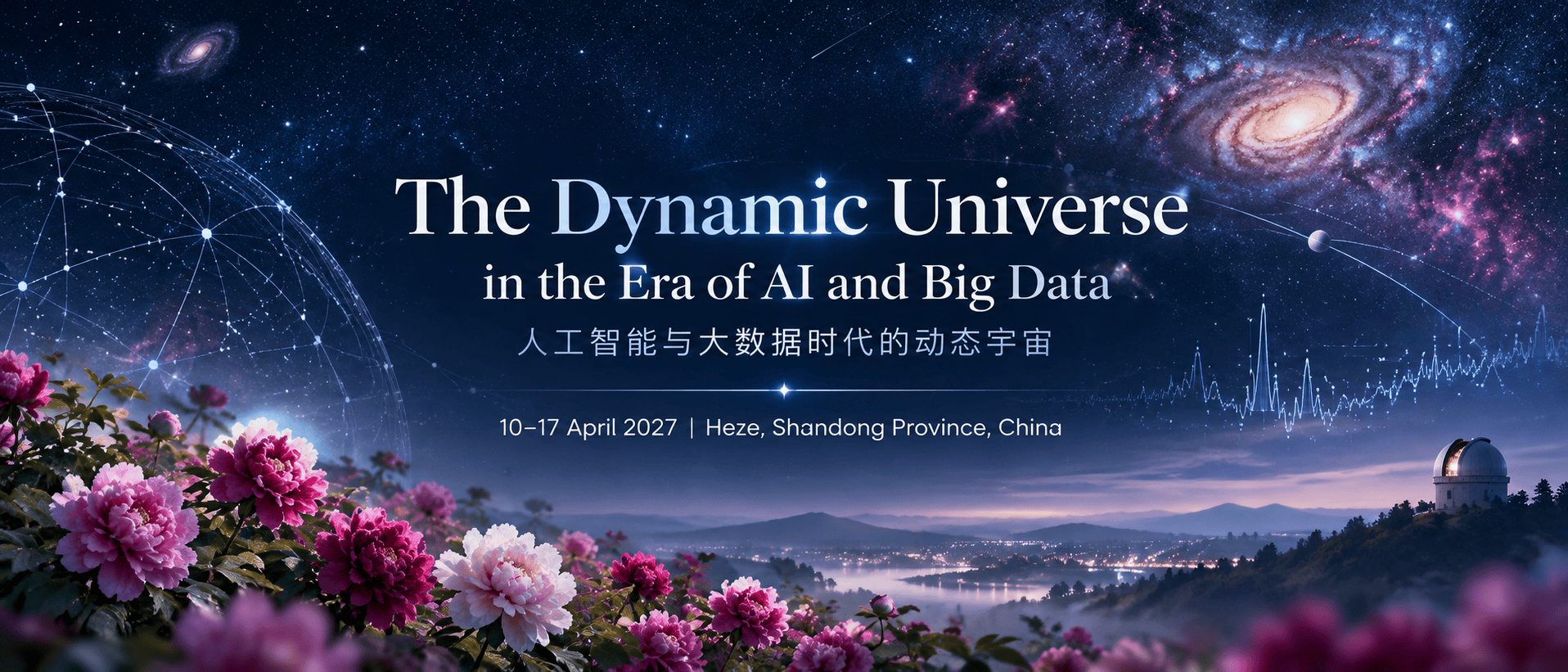
First Announcement
The Dynamic Universe in the Era of AI and Big Data
10–17 April 2027 | Heze, Shandong Province, China
Dear Colleagues,
The study of the dynamic Universe is entering an era of major scientific breakthroughs. Frontier topics such as gravitational-wave electromagnetic counterparts, supernovae, tidal disruption events, fast radio bursts, active galactic nuclei, exoplanets, and solar and stellar activities increasingly rely on high-cadence, continuous, and rapid-response time-domain observations. As a new generation of optical, radio, high-energy, and gravitational-wave facilities comes online, astronomy is moving beyond a primarily “static” view of the Universe toward a systematic exploration of transients, explosive phenomena, and astrophysical evolution across a wide range of timescales.
At the same time, artificial intelligence and big data are profoundly reshaping the research paradigm of astronomy. Faced with massive, heterogeneous, multi-source, and real-time data streams, AI is increasingly connecting the full scientific workflow—from observatory control, data transmission and processing, to scientific foundation models, anomaly discovery, physical-parameter inference, automated follow-up observations, and autonomous scheduling of intelligent observatories. Astronomy is therefore evolving from a predominantly data-driven discipline toward a new era of AI-enabled and increasingly intelligent scientific discovery.
Transient phenomena are short-lived and know no national boundaries, making continuous monitoring difficult for any single observatory, institution, or country to achieve alone. Globally distributed time-domain observing networks and computing and storage resources, high-speed intercontinental data transmission, coordinated operation of multiple facilities, and unified collaborative data-processing platforms are therefore becoming indispensable components of future time-domain astronomy. Achieving truly global coverage and continuous follow-up will require countries, observatories, and research teams to work more closely and efficiently together, guided by the principles of open science, multilateral cooperation, mutual trust, and international coordination.
In this landscape of scientific opportunity, technological transformation, and growing international collaboration, the international conference “The Dynamic Universe in the Era of AI and Big Data” will be held in Heze, Shandong Province, China, from 10 to 17 April 2027. The meeting is expected to bring together approximately 500 scientists, engineers, and early-career researchers from around the world to discuss frontier science of the dynamic Universe, next-generation observing facilities, artificial intelligence and big-data technologies, and future international collaboration.
The conference will address frontier scientific questions, observing facilities, data resources, artificial intelligence, and international collaboration related to the dynamic Universe. Topics will include, but are not limited to:
* Multi-messenger transients and the extreme Universe;
* Supernovae, tidal disruption events, gamma-ray bursts, and fast radio bursts;
* X-ray transients and high-energy time-domain phenomena;
* Solar and stellar activities, binary systems, and variable stars;
* Exoplanets, Solar System objects, and dynamic phenomena in the nearby Universe;
* Active galactic nuclei, time-domain cosmology, and large-sample studies of variable and transient sources;
* Large-scale time-domain surveys, array-based surveys, and next-generation observing facilities;
* Antarctic astronomy, global observing-station networks, and coordinated ground- and space-based observations;
* Astronomical photographic plates, historical observations, and long-baseline time-domain studies;
* Artificial intelligence, scientific foundation models, and intelligent observatories;
* Numerical telescopes, real-time data processing, and key enabling technologies;
* The Astronomy Technology Alliance (ATA) initiative and global collaboration in astronomical technology;
* Open science, data interoperability, and international coordination.
Beyond scientific exchange, the conference aims to actively promote concrete international cooperation toward the development of shared observing networks, interoperable data infrastructures, and collaborative AI platforms. By engaging multilateral mechanisms, this meeting seeks to foster an open, inclusive, and mutually beneficial framework for the next generation of dynamic Universe research.
The final scientific themes and session structure will be developed by the Scientific Organizing Committee (SOC) and the individual Session Scientific Organizing Committees (Session SOCs), and will be announced subsequently.
The conference is expected to include plenary invited talks, parallel scientific sessions, contributed talks, poster presentations, panel discussions, and round-table discussions, providing opportunities for in-depth exchange across different scientific fields, observing facilities, and areas of science, technology, and data.
Researchers at all career stages are welcome to participate. We particularly encourage the participation of early-career scientists and researchers working across astronomy, artificial intelligence, instrumentation, data science, scientific computing, and related interdisciplinary fields.
September 2026
First Announcement and conference website launch
Late 2026
Registration and abstract submission open
January 2027
Tentative deadline for abstract submission
February 2027
Second Announcement and preliminary scientific programme
10–17 April 2027
Conference in Heze, Shandong Province, China
Detailed deadlines and updates will be provided on the conference website as preparations progress.
Information regarding registration, abstract submission, accommodation, travel, visa assistance, official invitation letters, and possible financial support will be provided through the conference website and the Second Announcement.
The Scientific Organizing Committee, invited speakers, detailed session structure, preliminary programme, and other practical information will also be announced in due course.
We warmly welcome scientists, engineers, and early-career researchers from around the world to join us in Heze to exchange new results on the dynamic Universe, explore new opportunities for astronomy in the era of AI and big data, and promote deeper collaboration across global observing facilities, data resources, and intelligent scientific capabilities.
The Conference Organizing Committee
Dynamic Universe in the Era of AI and Big Data
September 2026