First Announcement
2026-05-12 00:00:00
Abstract Submission Deadline
2026-09-04 00:00:00
Notification of Abstract Acceptance
2026-09-15 00:00:00
Registration Deadline
2026-09-30 00:00:00
Conference Time
2026-11-02 09:15:00
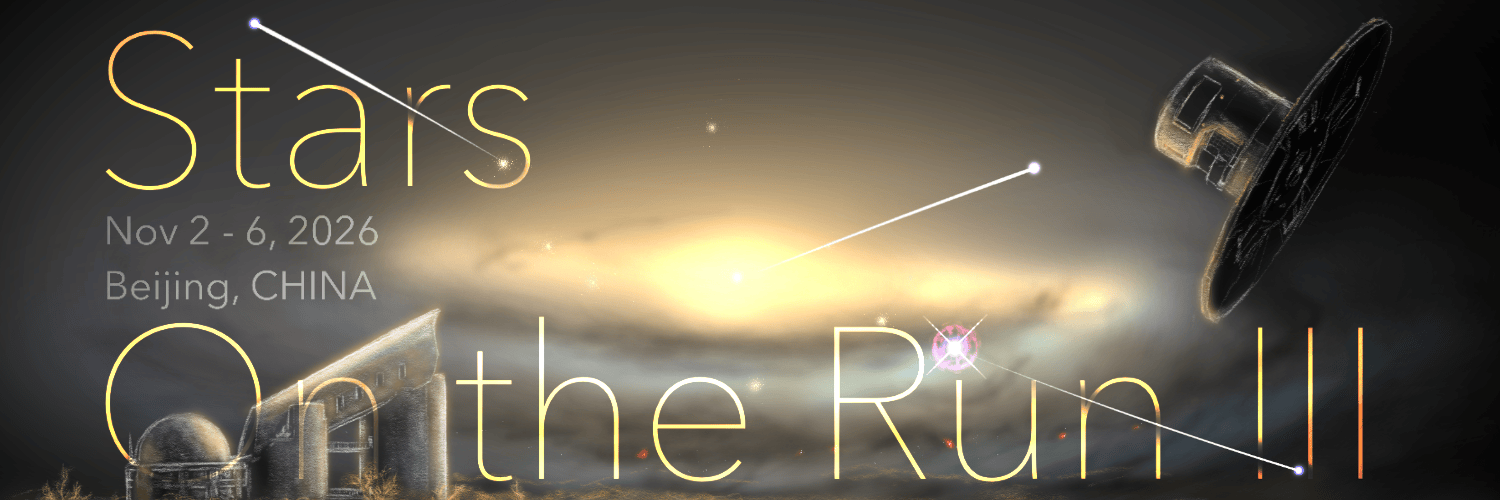
Hypervelocity and high-velocity stars provide a powerful probe of a wide range of fundamental astrophysical processes, including the dynamical influence of massive black holes, stellar interactions in dense environments, binary evolution and supernova physics, and the assembly history of the Milky Way and its satellite systems.
Since the second Stars on the Run meeting in 2019, the field has undergone rapid and transformative progress. The release of Gaia DR3, together with extensive spectroscopic follow-up from surveys such as LAMOST, SDSS, and DESI, has greatly expanded the known population of high-velocity stars and enabled robust studies of their kinematics, chemistry, and stellar populations. At the same time, the discovery of new classes of objects, most notably hypervelocity white dwarfs, has significantly broadened the scientific scope of the field.
Looking ahead, ongoing and upcoming spectroscopic facilities, including DESI, SDSS-V, WEAVE, and 4MOST, are expected to drive major advances in the near future by providing precise radial velocities, detailed chemical abundances, and time-domain spectroscopy for large samples of high-velocity stars. In parallel, the anticipated release of Gaia DR4 will further transform the field through improved astrometry, expanded radial velocity measurements, and enhanced binary information.
This workshop aims to provide a timely forum for the community to:
Review and synthesize recent observational and theoretical progress enabled by Gaia DR3 and current spectroscopic surveys;
Discuss new discoveries emerging from LAMOST, DESI, SDSS-V, WEAVE, and 4MOST;
Identify key open questions and challenges;
Prepare scientifically and strategically for the opportunities enabled by Gaia DR4.
The meeting will continue the tradition of Stars on the Run as a focused and highly interactive workshop, bringing together observers and theorists while actively supporting early-career researchers and promoting diversity and inclusiveness within the community.
The conference will mainly focus on the high speed stars, including But Not Limited to:
1. Origins of Hypervelocity and High-Velocity Stars
Hills mechanism, supernova ejection, and dynamical interactions; connections to the Galactic Centre, star clusters, and dwarf galaxies.
2. New Populations and Rare Objects
Hypervelocity white dwarfs and compact remnants; low-mass, metal-poor, and binary high-velocity stars.
3. Chemo-dynamical Properties and Stellar Populations
Kinematics, orbital reconstruction, and chemical abundances; links to Galactic components and stellar evolution.
4. Probing the Milky Way and Dark Matter Halo
Constraints on the Galactic potential and escape velocity; implications for dark matter distribution and Local Group dynamics.
5. Binary Evolution and Supernova Physics
Progenitor channels and evolutionary pathways; constraints on Type Ia supernovae and compact object formation.
6. Surveys, Data, and Methods
Results from Gaia DR3 and spectroscopic surveys (LAMOST, SDSS, DESI); methodologies including orbit reconstruction, statistical analysis, and machine learning.
7. Preparing for Gaia DR4 and Future Opportunities
Improved astrometry, radial velocities, and binary information; strategies for next-generation surveys such as SDSS-V, WEAVE, and 4MOST.
Ulrich Heber (co-chair),Friedrich-Alexander-Universität
Warren Brown (co-chair),Center for Astrophysics, Harvard & Smithsonian
Yang Huang (co-chair),University of Chinese Academy of Science
Qingjuan Yu,Peking University
Bo Wang,Yunnan Observatories
Elena Rossi,Leiden University
Abinaya Swaruba Rajamuthukumar,Max Planck Institute for Astrophysics
Roberto Raddi,Universitat Politècnica de Catalunya
Stephan Geier,University of Potsdam
Cuihua Du,University of Chinese Academy of Sciences
Huawei Zhang,Peking University
Yang Huang (co-chair)
Yongna Mao (co-chair)
Min Yang
Li Wang
Hongrui Gu
Chuanjie Zheng
Guiting Tian
Haozhu Fu
Jiahui Wang
Zhirui Li